





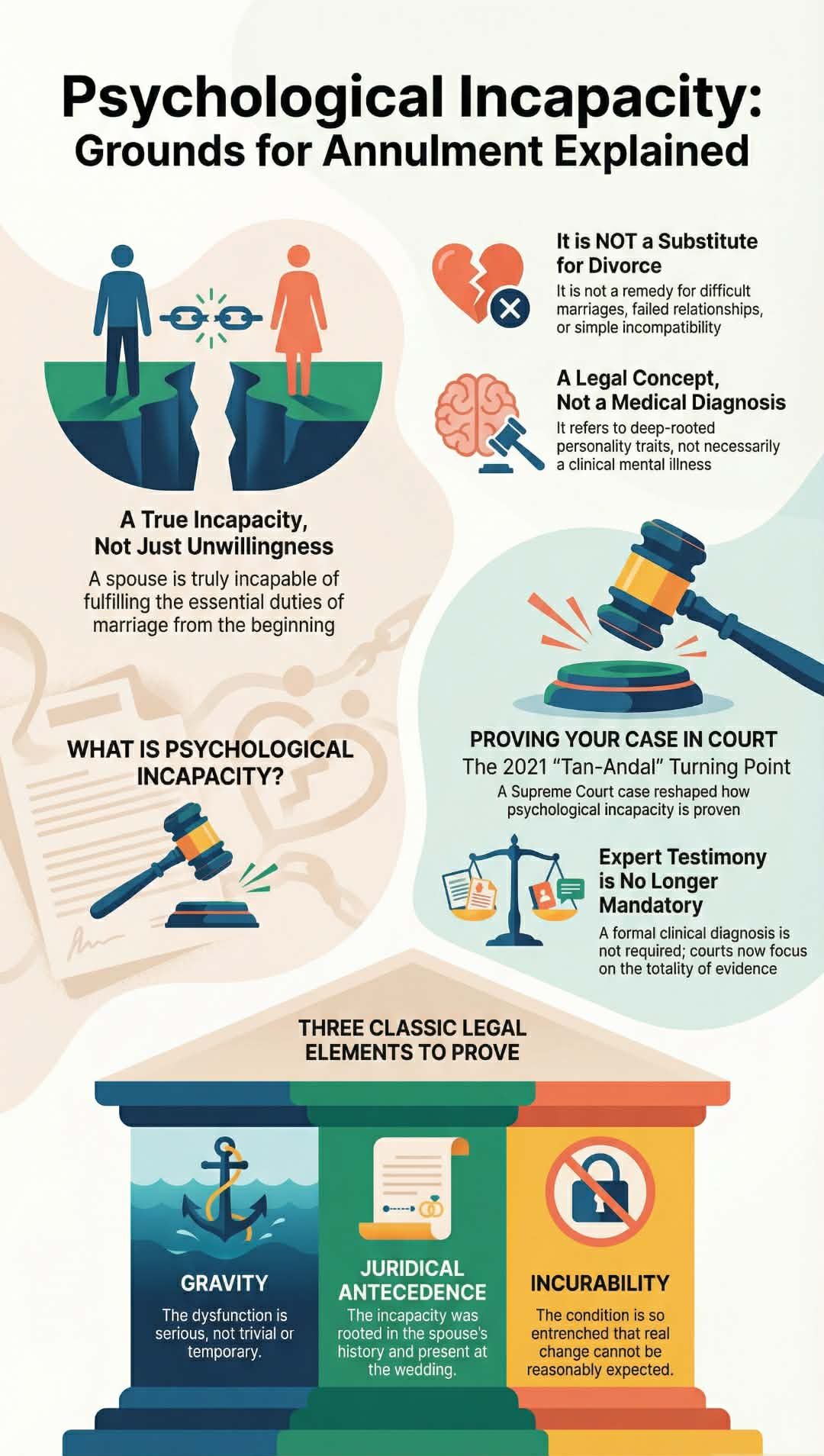
Article 36 of the Family Code states that a marriage is void if, at the time of the wedding, a spouse was psychologically incapacitated to comply with the essential marital obligations, even if the incapacity appeared only later.
In simple terms, Article 36 allows a declaration of nullity of marriage when, from the very beginning, one spouse was truly incapable — not just unwilling — to fulfill the basic duties of marriage.
It is not:
- a remedy for an unhappy or difficult marriage
- a way out of a “failed” relationship
- a substitute for divorce
A Legal, Not Medical, Concept
Psychological incapacity is a legal concept. It refers to deeply rooted personality traits that make it practically impossible for a spouse to understand and carry out essential marital duties such as:
- living together
- mutual love, respect, and fidelity
- support
- basic parental responsibilities
The Tan‑Andal Turning Point
In Tan‑Andal v. Andal (2021), the Supreme Court reshaped how Article 36 is applied. The Court clarified that:
- Psychological incapacity is not necessarily a mental illness or clinical disorder.
- Psychiatric or expert testimony is helpful but not mandatory.
- What matters are clear acts of dysfunctionality that undermine the marriage and family.
Subsequent cases (Espiritu v. Boac‑Espiritu, Montealto‑Laylo v. Ymbang, Republic v. Claur [Calingo]) reinforced that a formal clinical diagnosis is no longer indispensable, but the classic elements must still be proven:
| Element | Meaning in Practice |
|---|---|
| Gravity | Serious, not trivial or temporary. |
| Juridical antecedence | Rooted in the spouse’s history; present at the time of marriage. |
| Incurability | So entrenched real change cannot reasonably be expected. |
What Must Be Proven
A petitioner must show, by clear and convincing evidence, that:
- There is a real psychological condition causing serious and consistent marital dysfunction, beyond ordinary immaturity, infidelity, or incompatibility.
- The spouse is truly incapable of essential marital obligations, not simply refusing or being selfish.
- The condition existed at the time of marriage, traceable to the spouse’s personality, upbringing, or life history.
- The condition is incurable in a practical sense, such that genuine compliance with marital duties cannot reasonably be expected.
Courts now focus on the totality of evidence: narratives, witness testimonies, and documents (messages, records of abandonment, abuse, or chronic neglect) showing consistent patterns of dysfunction over time.
Article 36 remains a narrow, exceptional remedy. It applies only when, from the start, one spouse was truly and enduringly incapable of being a husband or wife in the legal sense.
Disclaimer: This blog is for general informational purposes only and does not constitute legal advice. Laws and legal interpretations may change, and every situation is unique. If you are contemplating filing a petition under Article 36 or any related case, consult a lawyer for proper legal advice tailored to your specific circumstances.